
Comments on records

Is it worth noting that this is more than likely the headplate from LIN-5A3F13?
Comment entered on record:
LIN-5A5469

Object type: Brooch
Broad Period: Early medieval
County of origin: Lincolnshire

This type of Flat Linear potin has an obverse depicting the outline head in the form of a continuous circle. It is a rare type, but is represented in both the Birchington and Sunbury hoards.
Comment entered on record:
SUR-DB57D6
Object type: Coin
Broad Period: Iron age
County of origin: Surrey

I am the finder of this hoard and have read this report. I believe the white cloudy condition refered to was due to the soil these were found in which contained what I think was limestone. The two complete bit broken axe heads were found with the broken pieces pushed inside of the cavity of the relevant axe head so were obviously deposited like this.
Comment entered on record:
YORYM-15AA2D

Object type: Hoard
Broad Period: Bronze age
County of origin: North Yorkshire

Tiffany Groenweghe (Louvain University; in litt.) distinguishes the moulded fluting typical of imported eastern Mediterranean vessels from the hammered fluting of Merovingian bowls of her Type A and notes the close similarity of the bowls in the Coptic Museum of Cairo illustrated in R. Richards's thesis, pl. 40 (Coptic Museum of Cairo), with further reference to the moulded fluted bowl from Sutton Hoo in pl. 56. For further information regarding "Coptic" bronze vessels she refers to:- - Dr Jörg Drauschke (Römisch-Germanisches Zentralmuseum,Mainz), 'New insights on the production of "Coptic" bronze vessels: A workshop on Elephantine Island (Aswan, Egypt)'. - Drauschke J., 2008: Zur Herkunft und Vermittlung "byzantinischer Importe" der Merowingerzeit in Nordwesteuropa, in: S. Brather (ed.), Zwischen Spätantike und Frühmittelalter. Archäologie des 4. bis 7. Jahrhunderts im Westen, Berlin - New York 2008, 367-423. - Daim, F. and Drauschke, J. (eds), Byzanz - das Römerreich im Mittelalter, Schnell & Steiner, Verlag RGZM, Mainz vol. 1, 2, 2.1, 2.2, 3 and 4, 2010.
Comment entered on record:
NMS-5F2A81
Object type: Vessel
Broad Period: Early medieval
County of origin: Norfolk

Hello, this is a beacon lead from 1661 from Haarlem and not a cloth seal. More information about this kind of leads on my website www.loodjes.nl or with the direct link to the Haarlem leads: http://www.loodjes.nl/CHB_I.html#HC . Kind regards Allex.
Comment entered on record:
SUR-BCC8A6
Object type: Cloth seal
Broad Period: Post medieval
County of origin: Bedford

I believe this is an Oldbury type bead (Guido type 53-57). date range 150BC - 150AD . similar to a number of other examples on the PAS YORYM-7DAAE6, LVPL-26BA21 and LON-041951
Comment entered on record:
LIN-3A9556
Object type: Bead
Broad Period: Iron age
County of origin: Northamptonshire

Two exact parallels of this cloth seal have been found in Durham City, see: Bankhead 2452 and 2464. as such, the pairs of initials shown can now be read as: HN RC (over) WA RB. The second disc displays the three towered castle of Norwich.
Comment entered on record:
SF-0D5996
Object type: Cloth seal
Broad Period: Post medieval
County of origin: Suffolk

Another close comparison for PUBLIC-09B192 comes from the Roman temple complex at Springhead, Kent. Cf. Schuster, J., 2011, Springhead metalwork, 189-291, in Biddulph, E., Seager Smith, R. and Schuster, J., Settling the Ebbsfleet Valley: HS1 excavations at Springhead and Northfleet, Kent - the late Iron Age, Roman, Saxon and medieval landscape Vol. 2: Late Iron Age and Roman finds reports. Salisbury, Oxford Wessex Archaeology, 268-9, fig. 118, 297.
Comment entered on record:
PUBLIC-09B192
Object type: Harness fitting
Broad Period: Roman
County of origin: The Vale Of Glamorgan

Research reference: Thomas, Gabor. Finds Research Group AD 700-1700, Datasheet 33.
Comment entered on record:
PUBLIC-CB60F8
Object type: Strap end
Broad Period: Early medieval
County of origin: Cheshire West And Chester

Hi Roland! I just stumbled across this entry - how lovely, another snowdrop ring! Can you do me a favour and add the other database numbers for the other rings to your references? That makes it easier for us to find them again (I have had another one in and will record it shortly! The others are: LANCUM-3DF1F3, LANCUM-C8F8D5, LANCUM-CF9042, DUR-2FE1B3, LANCUM-D83FF7 I am putting the new one on in a minute, so if you search the database for your ring's GAT number it should come up as well as I will be referencing yours! Dot x
Comment entered on record:
GAT-9847EC
Object type: Finger ring
Broad Period: Post medieval
County of origin: Gwynedd

A class 4b cut short cros halfpenny. This sub-class is dated circa 1200 - 1204 (J.P. Mass, SCBI 56), and is therefore likely that it was struck during the reign of King John.
Comment entered on record:
PUBLIC-F5469F
Object type: Coin
Broad Period: Medieval
County of origin: Cheshire West And Chester

This is a vessel sheet rivet mend. See Egan The Medieval Household p176
Comment entered on record:
SF-DE60E7
Object type: Strap fitting
Broad Period: Medieval
County of origin: Suffolk

This coin has recently been seen by Dr Stewart Lyon (Vice President of the BNS) and he informs me that the Moneyer is Edpine at EC (Exeter)
Comment entered on record:
SUSS-D911A6
Object type: Coin
Broad Period: Early medieval
County of origin: West Sussex
Interested in this rare find. Sam Moorhead has today (25 June 2014) identified a similar coin from Surrey. Could this comment be forwarded to Dr Vincent Drost who recorded the find. I would like to ask if any more is known about the location of the find.
Comment entered on record:
BM-96EF24
Object type: Coin
Broad Period: Roman
County of origin: Kent
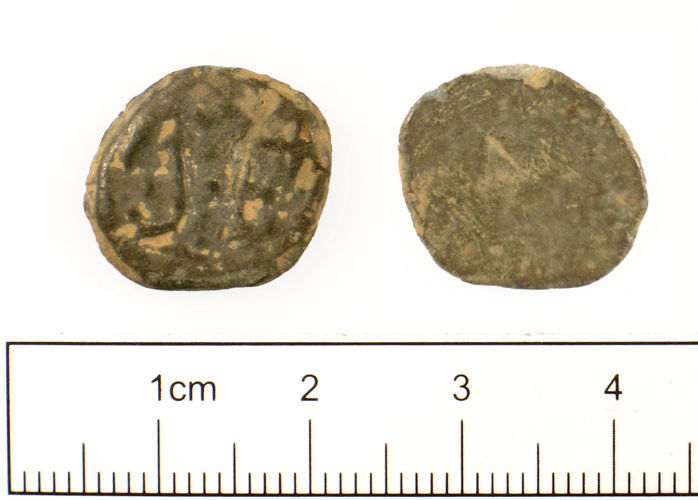
The letter J in this form was not in common usage until the 17th century. It is likely then that the token is post this date ie Post Medieval.
Comment entered on record:
SUSS-046A26
Object type: Token
Broad Period: Medieval
County of origin: East Sussex

What a lovely object! Could you rotate the image within the scale bars, though? Conventions dictate that socketed axes (miniature or big ones) should be photographed blade down. Thank you!!
Comment entered on record:
DUR-35C6C8
Object type: Miniature object
Broad Period: Roman
County of origin: East Riding Of Yorkshire

I have a similar item from Surrey (not yet recorded). We think it may be a scale pan fixing not a steelyard weight.
Comment entered on record:
BERK-873B70
Object type: Vessel
Broad Period: Roman
County of origin: West Berkshire
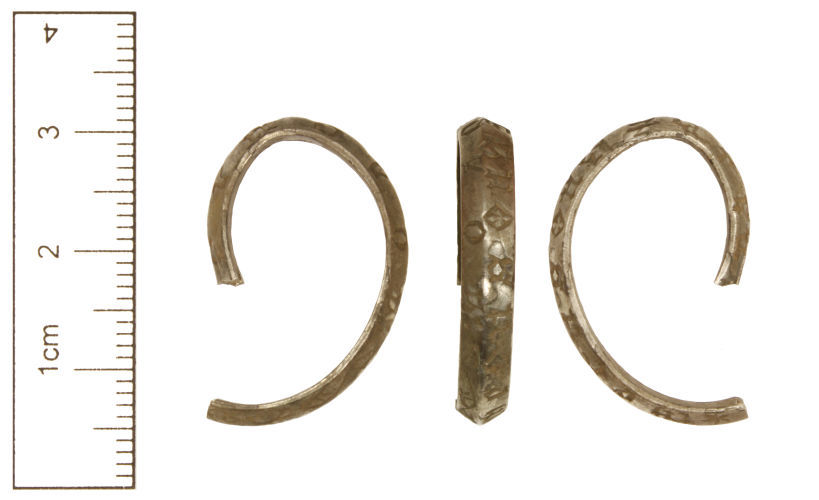
Hi Helen, I think you are right to be suspicious of describing this item as a vervel - there aren't any examples that I know of with this shape, and its weight would make it very heavy for a simple ring vervel without a shield. What does the inscription say? Cheers, Ian
Comment entered on record:
CAM-950533
Object type: Finger ring
Broad Period: Medieval
County of origin: Cambridgeshire

Or perhaps the terminal end of a seal top spoon
Comment entered on record:
SWYOR-BCB475
Object type: Spoon
Broad Period: Post medieval
County of origin: Rotherham

Duplicate entry for the ring is WILT-696257
Comment entered on record:
WILT-DEB017
Object type: Hoard
Broad Period: Roman
County of origin: Wiltshire

Hi, for my MA (Archaeology) dissertation I created a catalogue and typology of Romano-British bells, and can confirm that this is indeed Roman. It is of my Type 5 Shouldered bells. Parallels can be found at Hambleden Roman Villa, Bucks; Catterick; Richborough 150; Wroxeter 122, Carrawburgh Roman fort and York 6323. If you need them, I'm sure I can pull out the full references. There is no fixed date, so 1C - 4th C AD.
Comment entered on record:
SF-947455
Object type: Bell
Broad Period: Medieval
County of origin: Suffolk

This looks very much like a post medieval coat peg/hanger. The iron staining is where the screw part attached for fixing into wood
Comment entered on record:
NLM-564E12
Object type: Spoon
Broad Period: Post medieval
County of origin: Lincolnshire

Dear Katie, is this not a furniture fitting, a drawer handle backplate, cf. Margeson 1993, nos. 487-8?? Cheers, Andrew R.
Comment entered on record:
HAMP-71E6F6
Object type: Furniture fitting
Broad Period: Post medieval
County of origin: Hampshire
.jpg)
This looks like a fragment of a Post Medieval key hole cover
Comment entered on record:
PUBLIC-F02348
Object type: Furniture fitting
Broad Period: Post medieval
County of origin: East Sussex

I think that this is the shank from a rolled sheet metal pin, (cf Meols, Pl. 46, No. 3093). These are dated to the 16th century.
Comment entered on record:
SUSS-305C44
Object type: Stylus
Broad Period: Roman
County of origin: West Sussex

I think that 'AWL' might be a safer and more accurate identification. The date range would extend from the Early Bronze Age to Recent.
Comment entered on record:
YORYM-080053
Object type: Stylus
Broad Period: Roman
County of origin: North Yorkshire

Thank you for making these comments, Sally. I have duly corrected the record.
Comment entered on record:
KENT-8D6D44
Object type: Jetton
Broad Period: Medieval
County of origin: Kent

Hi, the hexagonal cross-section suggests that this is post-medieval or early modern curtain ring - or ring of other function, not prehistoric or Roman.
Comment entered on record:
LANCUM-CA67F2
Object type: Horse trapping
Broad Period: Roman
County of origin: Lancashire

Hi, this is a tanged and collared chisel probably of Late Bronze Age date, ie ca 1000-800BC.
Comment entered on record:
WMID-18C2F1
Object type: Unidentified object
Broad Period: Bronze age
County of origin: Staffordshire

Hi, what kind of axe does this fragment come from? Socketed axes are very rare here in the North West and I would be interested what this one came from. The image is not clear and with only one view it is difficult for me to date it or confirm identification.
Comment entered on record:
LANCUM-099711
Object type: Axe
Broad Period: Bronze age
County of origin: Cumbria

About Us
About our Site

Find us
The British Museum, Great Russell Street, London WC1B 3DG.
T: +44(0) 20 73238618